
Egg Timer Boil
A minute makes the difference between a runny yolk and a firm one. This egg timer uses tested boiling times for large eggs, adjusts for egg size, starting temperature, method and altitude, and counts down with an alarm — so you can walk away from the pan. Run several timers at once when some people want soft eggs and others hard.
- Free to use
- No sign-up
- Runs in your browser
Boiled egg timer
Egg Timing Kitchen Pack
Printable boiled egg timing chart for the fridge, egg size chart, batch-cooking planner and a weekly meal prep log.
- Timing chart (PDF)
- Egg size chart (PDF/XLSX)
- Batch planner (PDF/DOCX/XLSX)
- Meal prep log (PDF/DOCX/XLSX)
Formats: PDF, XLSX, DOCX. Instant download after payment (link valid 72 hours, up to 5 downloads). AI-assisted: the templates were drafted with AI help and reviewed and laid out before publishing.
$5.00 USD, one-time 4 files · about $1.25 each
- Instant download
- 7-day refund
- Secure checkout by Stripe
7-day money-back guarantee. Full refund within 7 days of purchase, even after you download.
Free sample: Boiled Egg Timing Chart (PDF, 66 KB)
Full refund within 7 days — see the refund policy and license.
Free printables
Single sheets you can print right now, no sign-up. The full pack adds every sheet in one download plus the editable files.
 Printable Egg Boil Timing Chart
 Printable Egg Size Chart
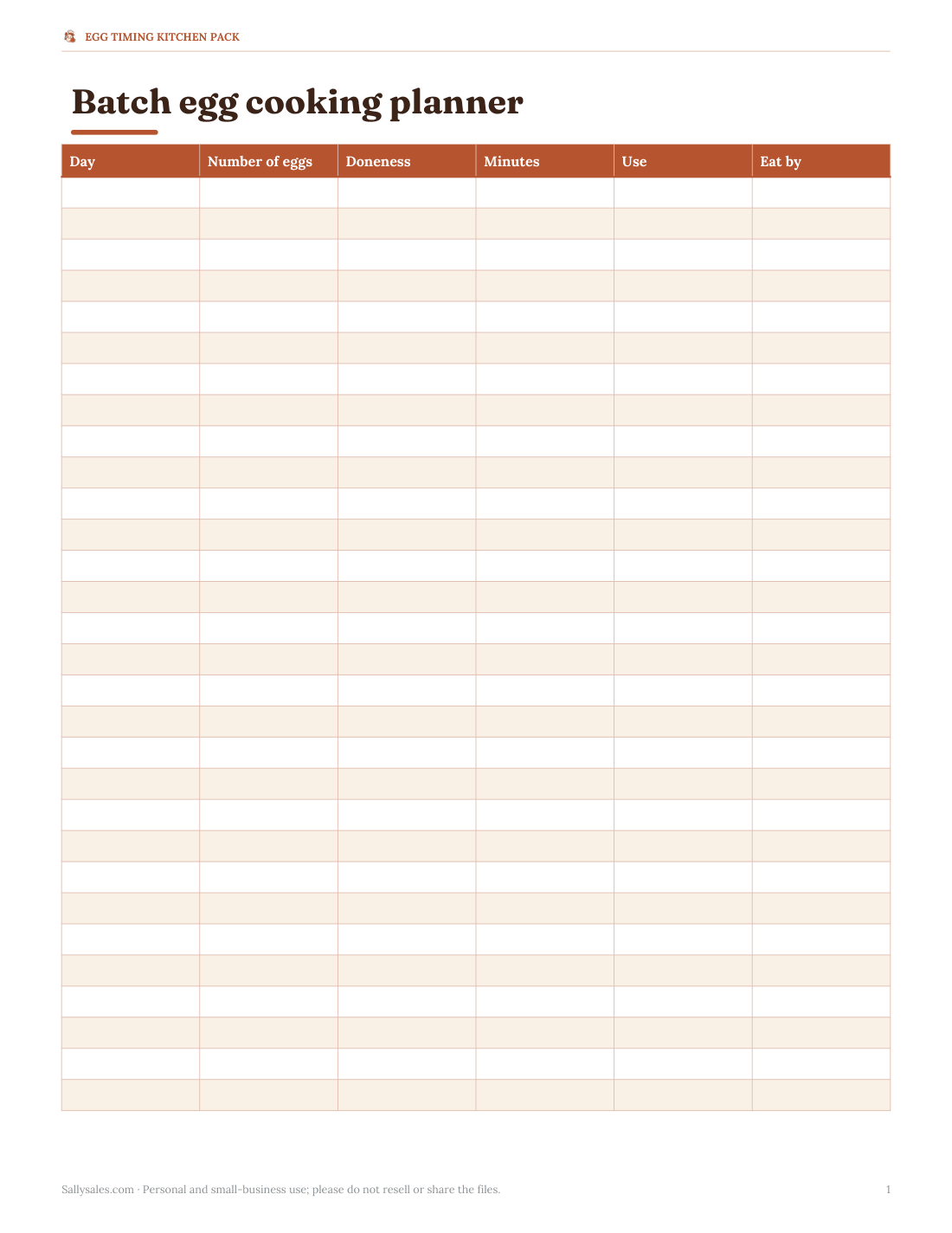
 Printable Batch Egg Cooking Planner
 Printable Weekly Meal Prep Log
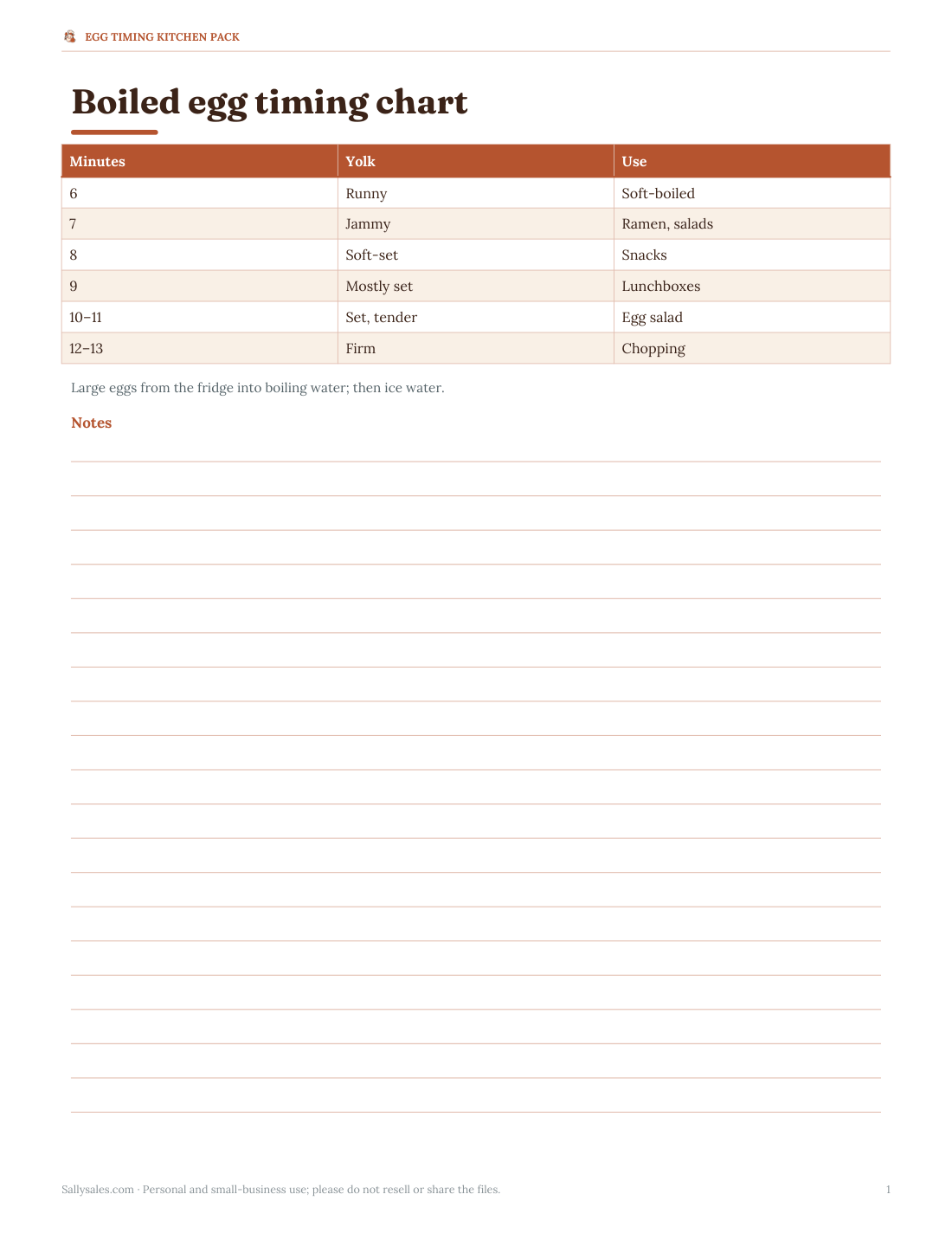
Boiled egg timing chart (large eggs, from the fridge)
| Minutes in boiling water | Yolk | White | Good for |
|---|---|---|---|
| 5 | Very runny | Barely set near the yolk | Dipping soldiers (for confident soft-egg fans) |
| 6 | Runny | Just set | Soft-boiled eggs in cups |
| 7 | Jammy, thick | Set | Ramen, salads, toast |
| 8 | Soft-set, slightly fudgy | Firm | Snacks, grain bowls |
| 9 | Mostly set | Firm | Lunchboxes |
| 10–11 | Fully set, still tender | Firm | Egg salad, devilled eggs |
| 12–13 | Firm and pale | Firm | Chopping, grating |
Times assume large eggs (about 50 g in shell, US “large” ≈ 2 oz) lowered straight from the fridge into water at a rolling boil, then cooled in ice water. Stoves, pans and egg sizes vary, so treat the chart as a starting point and adjust by 30 seconds to taste.
Adjusting for egg size and temperature
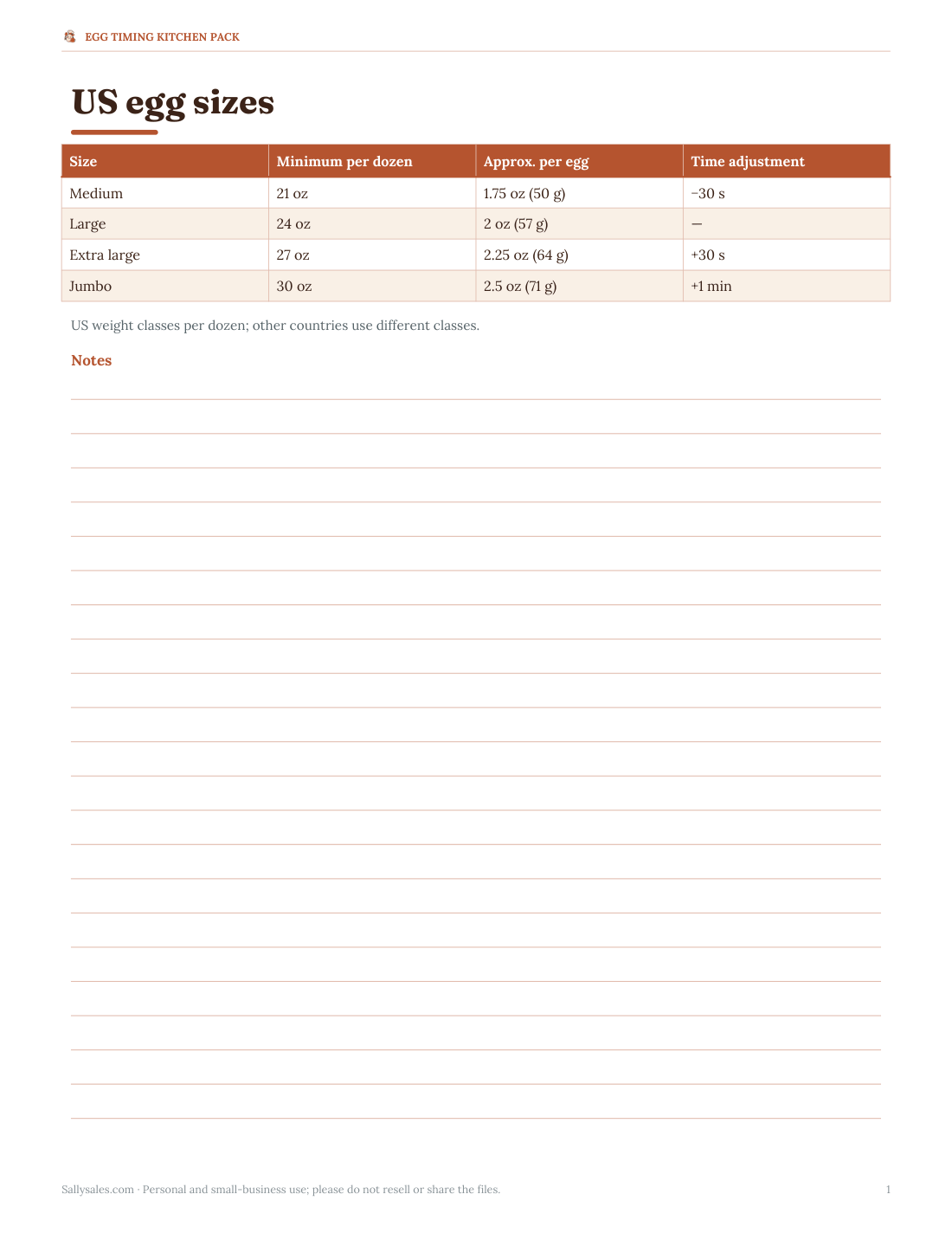
| Change | Adjust time by |
|---|---|
| Medium eggs | −30 seconds |
| Extra-large eggs | +30 seconds |
| Jumbo eggs | +1 minute |
| Room-temperature eggs | −1 minute |
| Lots of eggs in a small pan | Water takes longer to return to the boil — use a bigger pan or add time |
| Altitude above ~1,500 m (5,000 ft) | Water boils cooler — add 1 minute or more, and test |
At higher altitude, water boils below 100 °C (about 95 °C at 1,500 m), so eggs cook more slowly. The timer adds a minute in the middle altitude band and two above about 2,500 m; do a test egg the first time.
Three methods compared
| Method | How | Pros | Cons |
|---|---|---|---|
| Boiling start | Lower eggs into boiling water | Most consistent timing; easier peeling | Eggs can crack if dropped |
| Steaming | Eggs in a covered pan over 2–3 cm of boiling water | Very consistent, quick, easy to peel | Needs a lid |
| Cold start | Eggs in cold water, brought to the boil | Less cracking | Timing varies with stove and pan; often harder to peel |
Worked example
Breakfast for two: one person wants a runny yolk, the other hard-boiled. Both use large eggs straight from the fridge. Start a “Soft” timer for 6 minutes and a “Hard” timer for 11 minutes as the eggs go into the boiling water. When the first alarm goes, lift out the soft egg into ice water for a minute (just to stop the cooking); when the second rings five minutes later, move the hard egg into ice water for several minutes before peeling. With jumbo eggs, each time would be a minute longer.
Peeling tips
- Very fresh eggs are harder to peel — eggs a week or two old peel more easily.
- Starting in boiling water (or steam) makes peeling easier than a cold start.
- Cool the eggs in ice water, then crack all over and peel under running water, starting at the wide end where the air cell is.
- Hard-boiled eggs keep in the fridge for about a week in the shell; peeled eggs are best eaten within a few days.
Other ways to cook eggs
| Style | Approximate time | Notes |
|---|---|---|
| Coddled | 4–6 min in just-off-boil water | Gentle heat; soft white |
| Poached | 3–4 min in barely simmering water | Fresh eggs hold their shape best |
| Air fryer “boiled” | about 13–16 min at 130–150 °C (270–300 °F) | Varies a lot by model — test first |
| Pressure cooker | often about 5 min high pressure + 5 min release + ice bath (the “5-5-5” method) | Consistent; very easy to peel |
| Sous vide | often 63–65 °C for about 45–60 min for a custardy egg | Precise but slow |
These are common starting points from recipes rather than exact rules; appliances differ, so test one egg before cooking a batch.
Food safety
Soft and jammy yolks aren’t fully cooked. Food safety agencies advise that people who are pregnant, young children, older adults and people with weakened immune systems eat eggs with firm yolks unless the eggs are pasteurised or produced under schemes considered safe for runny eggs in your country. Refrigerate cooked eggs within two hours.
Using the timer
Choose your yolk, size, starting temperature, method and altitude, give the timer a name and press Start. You can start several timers — for different people or batches — and each counts down on its own with a progress bar and an alarm. Keep this tab open; the browser tab title changes when a timer finishes. The optional pack includes a printable timing chart for the fridge door, an egg size chart, a batch-cooking planner and a weekly meal prep log.
AI-assisted content
This page was drafted with AI assistance and reviewed before publishing. Times are typical; adjust to your stove.
Frequently asked questions
How long do you boil an egg for a runny yolk?
About 6 minutes for a large egg straight from the fridge, lowered into boiling water.
How long for a hard-boiled egg?
About 10–12 minutes for large eggs, then ice water.
What is a jammy egg?
An egg with a thick, sticky yolk — about 7 minutes for a large egg.
Do I start eggs in cold or boiling water?
Boiling water gives more consistent timing and easier peeling; cold starts work but vary.
Why are my eggs hard to peel?
Very fresh eggs and cold-water starts make peeling harder; ice water helps.
Can I run more than one timer?
Yes — start as many as you need; each has its own countdown and alarm.
Should I add salt or vinegar to the water?
It isn’t necessary; some cooks add vinegar to help set whites if a shell cracks.
How long do hard-boiled eggs keep?
About a week in the fridge in their shells.